Autonomous UAS and AI mission systems for complex operating environments.
maxUAS develops autonomous UAS and AI mission systems for complex civil, industrial, public-sector, and defence/security environments. Our portfolio combines Sentinel-AI operational intelligence, the Ranger-AI bolt-on intelligence module, and GS, the operator console for mission planning, live video, telemetry, and fleet control.
Sentinel-AI is a standalone, platform-agnostic intelligence layer that helps teams make sense of sensor, imagery, telemetry, and field data in real time. Ranger-AI is a ruggedized module that bolts onto virtually any drone — quadcopter, fixed-wing, or VTOL — adding GNSS-denied navigation, diversity mesh communications, and edge AI & autonomy the base platform doesn't have on its own.
Our systems are built around Canadian-controlled engineering, auditable supply chains, and non-adversarial component strategies, designed for cold-weather, Arctic, GNSS-challenged, and infrastructure-limited environments — conditions where operational reliability and traceable, auditable decision-making matter most.
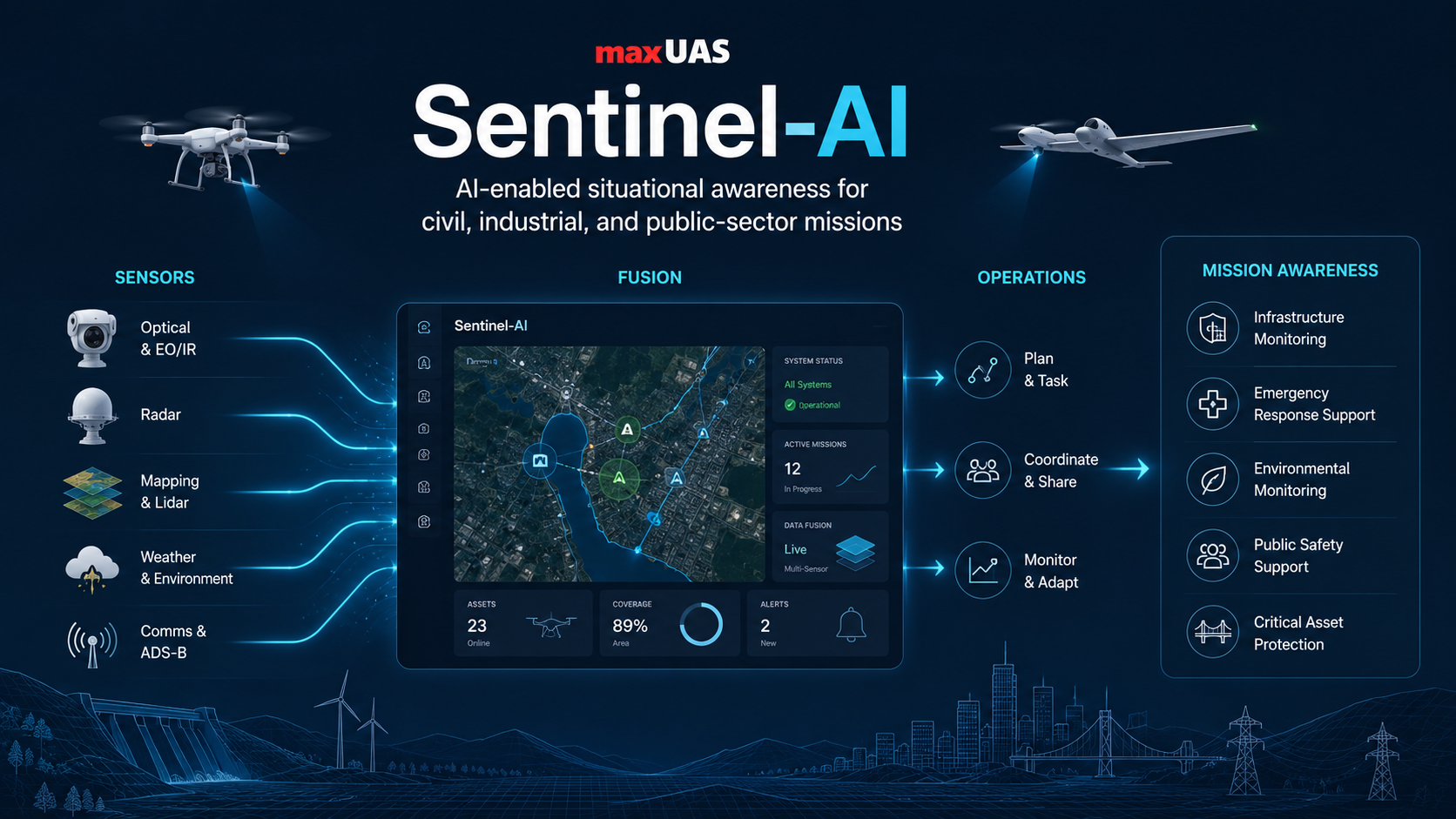
From sensor observations to operator-ready decisions.
Sentinel-AI is a standalone, platform-agnostic intelligence layer that connects third-party sensors, existing operational systems, overhead imagery, telemetry, operator inputs, customer data, and simulated mission sources into one decision workflow. It turns raw input into decision-ready intelligence for the people in the field and the people directing them — while preserving evidence, confidence, provenance, and human oversight.
Rather than treating each drone, camera, radar feed, RF cue, acoustic cue, customer data source, inspection record, or historical mission dataset as a separate island, Sentinel-AI brings them together into a common structure for track management, sensor correlation, mission alerts, operator confirmation, audit logs, reporting, and operational intelligence. It's the fusion half of the edge-to-operator pipeline described above; Ranger-AI is the edge half.
The gap: detection alone is not enough
Many systems detect and alert, then leave operators to investigate, maintain contact, and coordinate next steps manually. In Arctic, maritime, remote, public-safety, and forward-site environments, operator-intensive models can become difficult to sustain when infrastructure, connectivity, weather, or response time is constrained.
The solution: Sentinel-AI closes the loop
Sentinel-AI is positioned as an integrated awareness, coordination, and response system. It supports informed decision-making, deploys or cues response assets when configured, maintains visibility, and records key decisions within customer-defined rules, oversight levels, and compliance requirements.
Multi-modal sensor fusion
Ingest and correlate radar, EO/IR, RF, acoustic, telemetry, UAS, and external sensor observations into a common operating picture.
Operator-in-the-loop control
Support policy-based automation where cueing, investigation, tracking, and response coordination remain aligned with authorization levels and safety controls.
Interoperability-ready architecture
Designed for integration pathways with sensor adapters, mission planning tools, command systems, telemetry streams, and standard data formats.
Operator decision support
Sentinel-AI is designed to help operators prioritize what matters: where the object is, what evidence supports it, how confident the system is, what changed, and what next action is available under customer policy.
Add onboard intelligence to any drone.
Ranger-AI is a ruggedized intelligence module that bolts onto virtually any drone — quadcopter, fixed-wing, or VTOL — and adds advanced onboard capability the base platform doesn't have on its own. Because it's a self-contained module rather than a specific airframe, it turns existing and third-party fleets into intelligent platforms, and provides the compute-and-sensing foundation on which more advanced AI functionality is built over time.
One module, any airframe
Ranger-AI is designed to attach to fleets already in service and to third-party aircraft, not just maxUAS-built platforms. It upgrades what the customer already flies rather than requiring a new airframe purchase, and it establishes a consistent onboard intelligence layer across a mixed fleet.
Works hand-in-hand with Sentinel-AI
Ranger-AI is the edge half of the pipeline described above — it hands processed data to Sentinel-AI for fusion and reasoning, keeping decision-making traceable and auditable from aircraft to operator.
GNSS-denied navigation
SLAM, visual-inertial odometry, optical flow, AI-enhanced sensor fusion, and terrain-relative navigation, so the aircraft keeps positioning when GPS is jammed, spoofed, or unavailable.
Diversity mesh communications
A resilient mesh networking protocol that keeps aircraft connected to each other and to the ground station across contested or infrastructure-limited RF environments, with no cloud or cellular dependency.
AI & autonomy
Onboard edge-AI inference and swarm coordination, enabling multi-aircraft cooperation and autonomous decision-making at the edge.
Secure by design
Quantum-resistant (post-quantum) encryption integrated directly into the communications stack, protecting command, telemetry, and mesh links.
Live video from aircraft to operator
Ranger-AI carries live digital FPV over its resilient mesh link, giving GS operators an integrated view for piloting, observation, and mission awareness.
Cold-weather operation
Battery management and hardware rated for −40 °C, Arctic, and infrastructure-limited environments, so onboard intelligence keeps running where reliability matters most.
One architecture, configured as mission kits
The same compute-and-sensing foundation is tuned differently per use case — see Ranger-AI mission kits for Arctic, ISR, mapping, and perimeter configurations built on this architecture.
Mission kits that extend the same platform family across different use cases.
Ranger-AI is the platform family — one module architecture covering onboard compute, GNSS-denied navigation, diversity mesh comms, edge AI, and security. Rather than spreading one sensor concept across new hardware for every use case, each mission kit pairs that same Ranger-AI foundation with the sensor package, autonomy level, and Sentinel-AI integration a specific mission calls for — and still bolts onto whatever airframe the customer already flies.
Arctic / Cold-Ops kit
Cold-weather battery management, terrain-relative and visual-inertial navigation tuned for sustained high-latitude flying, and mesh comms profiles built for sparse ground infrastructure.
ISR / Defense kit
Edge-AI detection models, swarm coordination emphasis, and a hardened security posture, integrated with Sentinel-AI's evidence handling and audit trail for regulated environments.
Infrastructure / Mapping kit
Precision positioning and edge pre-processing tuned for photogrammetry, LiDAR, and inspection workflows, producing consistent data across repeated sorties rather than one-off collections.
Border / Perimeter kit
Mesh-relay emphasis and an extended-endurance power profile for patrol routes and perimeter overwatch, with cueing handed off to Sentinel-AI for coordinated response.
Ranger-AI is customized with different sensors to meet each mission.
Each kit above is the same Ranger-AI module paired with the sensor package a mission calls for. The options below are that customization layer — combined with the appropriate autonomy level, onboard compute tier, communications package, and Sentinel-AI integration.
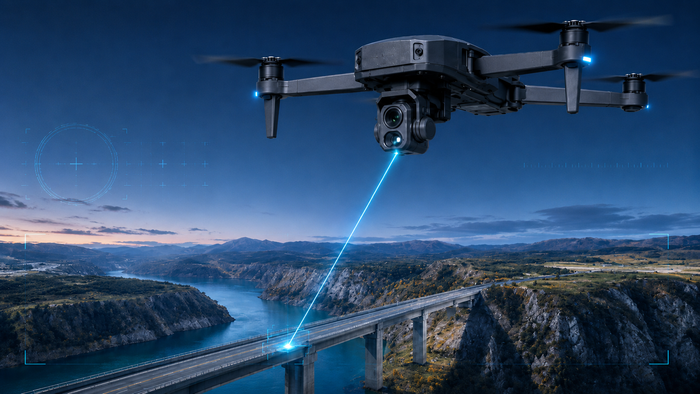
Laser range-finder
A compact laser range-finder sensor can support precision ISR, range measurement, target cueing, and operator-confirmed observation records. Paired with stabilized imaging, platform pose metadata, timestamps, and Sentinel-AI evidence handling, range measurements become part of a traceable mission data product rather than a standalone sensor reading.
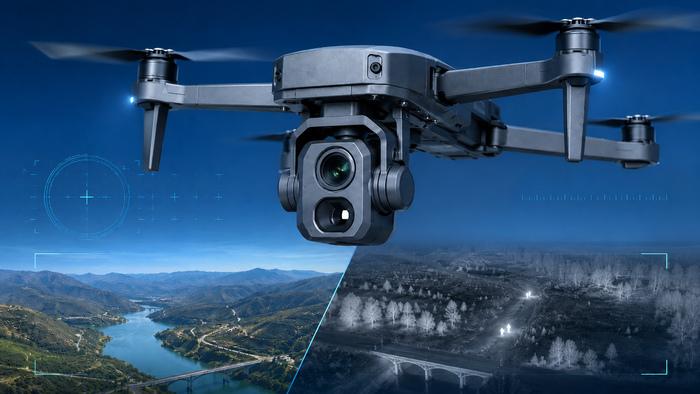
EO/IR and stabilized camera
Day/night imaging sensors support inspection, search, overwatch, reconnaissance, perimeter monitoring, maritime awareness, and emergency response. Stabilization and repeatable flight planning help operators collect consistent imagery across multiple sorties.
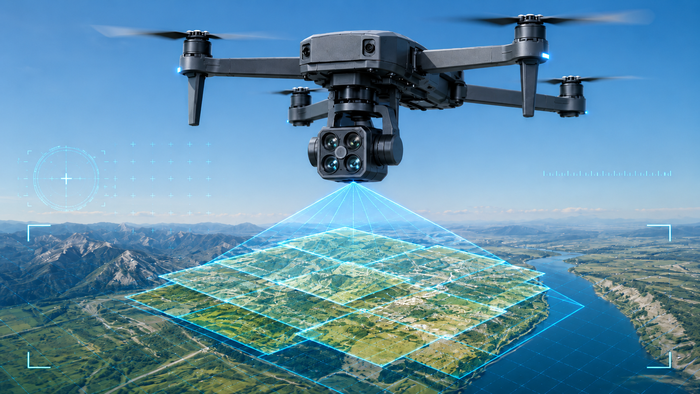
Mapping and photogrammetry
High-resolution mapping cameras for orthomosaic generation, survey workflows, construction documentation, terrain analysis, and repeatable site monitoring.
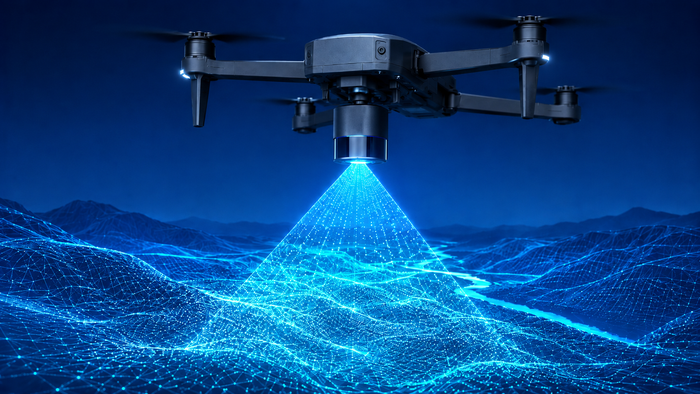
LiDAR / terrain sensing
Optional terrain and structure sensing for vegetation penetration, elevation models, infrastructure inspection, and operations where image-only mapping is not sufficient.
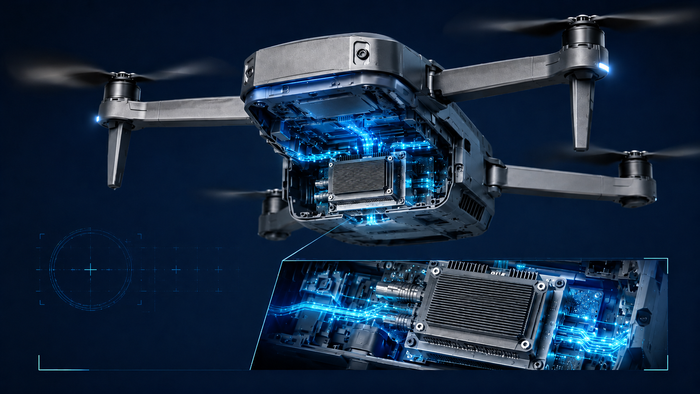
Expanded edge AI compute
A heavier onboard compute tier on top of Ranger-AI's base edge AI, for local detection assistance, sensor pre-processing, video analytics, and degraded-link operation on compute-intensive missions.
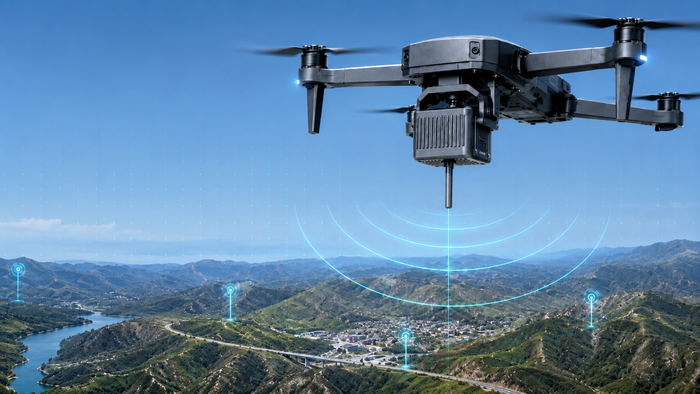
RF detection
RF sensing options for signal awareness, emitter detection support, spectrum monitoring, and correlation with other Sentinel-AI observations.
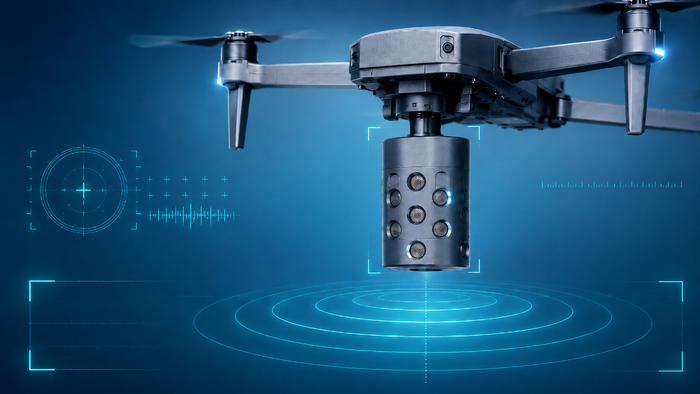
Acoustic sensing
Acoustic sensors or ground-linked acoustic feeds can contribute additional detection evidence in airspace awareness, security, and environmental monitoring scenarios.
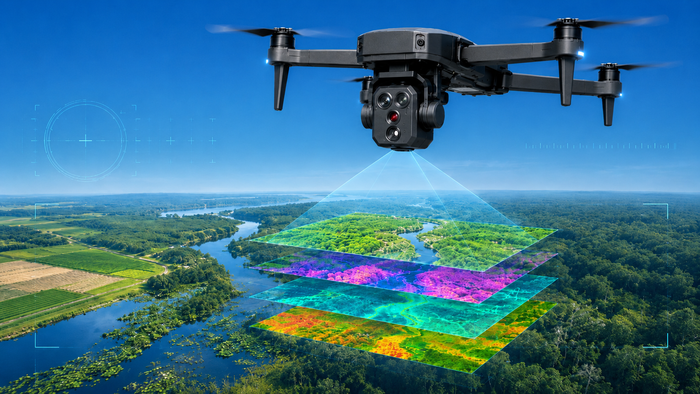
Multispectral / environmental
Options for forestry, agriculture, coastline, wetlands, habitat, snow/ice, and environmental monitoring where specialized bands or sampling data are useful.
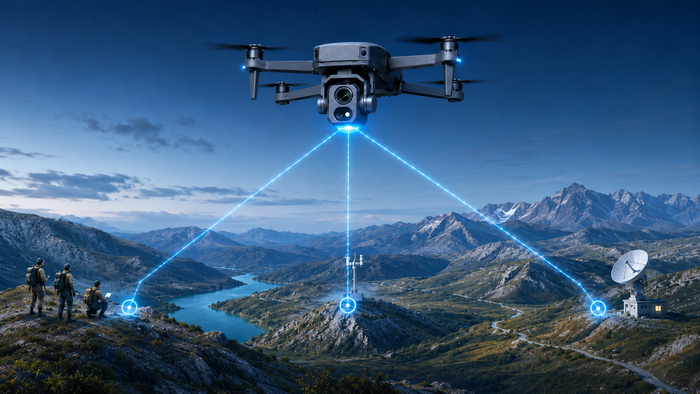
Communications relay
Airborne relay sensors extend network reach beyond Ranger-AI's base mesh, support field teams, improve coverage in terrain-limited areas, and maintain mission continuity when infrastructure is limited.
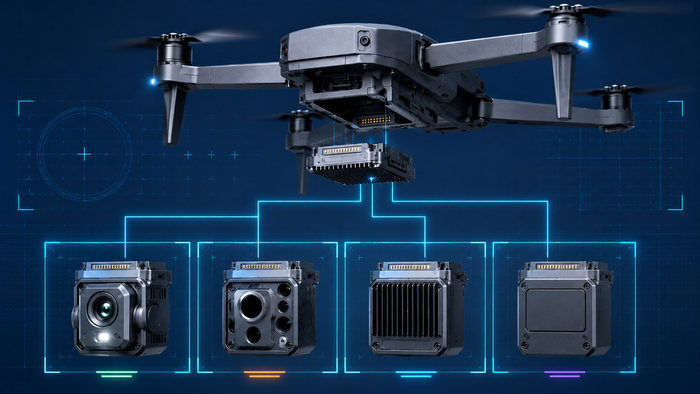
Custom customer sensors
Customer-defined sensors can be integrated through Ranger-AI's modular power, data, mounting, sensor identification, and operator workflow interfaces when mission requirements demand a specialized configuration.
One architecture, not a parts list
Mission kits don't swap the Ranger-AI module itself — they pair its compute, navigation, comms, and security stack with the sensor package above. A customer moving from an infrastructure program into a security program reconfigures rather than re-platforms.
Sensor data stack
Sensor outputs such as EO/IR imagery, mapping data, range measurements, RF/acoustic observations, platform pose metadata, mission timestamps, and operator confirmation are combined through Ranger-AI into structured, traceable mission data products for Sentinel-AI.
Core building blocks for complex missions.
The emphasis is on practical mission execution: Sentinel-AI mission intelligence, Ranger-AI onboard capability, reliable autonomy, operator-aligned workflows, traceable outputs, and resilience in real operating environments.
Sentinel-AI mission intelligence
Standalone operational intelligence platform for connecting sensor, imagery, telemetry, customer, and field data into clearer situational awareness, confidence-supported insights, evidence handling, and operator-ready decision workflows.
Autonomy and mission execution
Support for autonomy levels that match the operator’s SOP, ranging from flight assistance to higher automation. Defined routes, geofences, predictable behaviours, and repeatable mission plans help teams collect comparable data across sorties.
Ranger-AI edge module
Bolt-on onboard intelligence for virtually any drone: GNSS-denied navigation, diversity mesh communications, edge-AI inference, swarm coordination, post-quantum encryption, and cold-weather resilience, tuned per use case through Ranger-AI mission kits.
Digital FPV over mesh
Live aircraft video carried over the Ranger-AI mesh link and presented in GS for operator control, observation, and mission awareness.
GS operator console
A streamlined command point for mission planning, live FPV, telemetry, and control of Ranger-AI-equipped aircraft.
Integration & interoperability pathways
Integration points for mission planning, telemetry, sensor feeds, command workflows, and customer-specific toolchains, including SAPIENT-style sensor integration, ASTERIX radar track ingestion, Cursor-on-Target style messaging, and ATAK-compatible operational workflows — reducing friction when UAS outputs need to fit into existing operations.
Cold-weather operational resilience
Environmental design considerations, cold-weather power planning, maintainability, variable-terrain deployment, logistics constraints, and infrastructure-limited workflows for harsh Canadian and Arctic operating realities.
Rapid deployment and fieldability
Focus on setup time, serviceability, maintainability, logistics, and mission packages that can be swapped or reconfigured without requiring extensive engineering effort in the field.
Safe, repeatable data capture
Optimized for inspection, mapping, environmental monitoring, asset observation, and emergency response workflows where operational reliability and decision-quality data are more valuable than raw speed or novelty.
Configurable for regulated environments
Configurable for ISR, border/perimeter surveillance, force protection support, airspace awareness, and integration into broader security systems, subject to policy, compliance, and customer requirements.
Balanced mission coverage across civil, public-sector and regulated security environments.
All use cases are presented here as mission applications that can combine Sentinel-AI, Ranger-AI, host aircraft, external sensors, customer data, and operator workflows. Each application can be connected to Sentinel-AI when the customer needs sensor fusion, operator cueing, evidence handling, reporting, or decision support, and upgraded with Ranger-AI when aircraft need GNSS-denied navigation, resilient mesh comms, or onboard autonomy.
Infrastructure inspection
Repeatable inspection of utilities, bridges, industrial sites, rail, transportation assets, and critical infrastructure. The goal is consistent imagery and telemetry so teams can monitor change over time, reduce manual risk, and minimize downtime.
Mapping and surveying
Photogrammetry, survey support, land-use planning, project documentation, volume estimation, and large-area mapping with repeatable mission execution rather than ad-hoc flight collection.
Environmental monitoring
Forestry, coastal, wetlands, habitat, and remote-area monitoring with scheduled re-flights that produce comparable datasets across seasons, incidents, or program timelines.
Emergency response support
Situational awareness, scene mapping, and search support for disaster response and SAR teams, improving visibility and reducing time-to-information in dynamic environments.
Public events and sensitive locations
Support for public safety, government sites, transportation hubs, and sensitive locations where operators need situational awareness, controlled workflows, appropriate human oversight, and accountable records.
ISR and reconnaissance
Day/night ISR support through mission-configured payloads, autonomy options, repeatable routes, time-on-station, and consistent observation workflows.
Border and perimeter surveillance
Monitoring of sensitive areas, patrol routes, perimeter overwatch, coastal sites, and rapid response to cues from external sensors or operators.
Force protection support
Situational awareness for bases, forward sites, routes, public-sector facilities, and critical infrastructure where deployment speed and reliable visibility are essential.
Maritime domain awareness
Coastal and near-shore monitoring workflows where endurance and coverage are critical for littoral patrol, vessel observation, and wide-area awareness.
Forward and temporary site awareness
Deployable awareness for forward sites, temporary operating locations, public-sector facilities, and remote work areas where small teams need rapid setup, coordinated visibility, and recorded decision workflows.
Airspace and perimeter awareness
Airspace and perimeter awareness is one use case enabled by Sentinel-AI, Ranger-AI-equipped aircraft, external sensors, customer data, and operator workflows. Sentinel-AI can connect radar, EO/IR, RF, acoustic, telemetry, aircraft feeds, external cueing sources, and operator inputs into one coordinated operational picture to help teams detect, review, track, coordinate, and record activity according to their policies, regulations, and mission requirements.
When configured for regulated security or counter-UAS support, this application can assist with detection-to-response coordination, operator cueing, evidence trails, audit logs, role-based response workflows, airborne investigation or overwatch support, and integration into broader security or C-UAS system-of-systems environments.
Navigation in contested RF
With Ranger-AI, host aircraft keep positioning and stay networked where GPS is jammed or spoofed — using SLAM/VIO, optical flow, terrain-relative navigation, and diversity mesh communications with no cloud or cellular dependency.
Arctic and High North support
Support for remote and cold-weather operating areas where distance, weather, infrastructure limits, and communications constraints make reliable awareness, fieldability, and traceable mission data important.

From requirements to operational configuration.
maxUAS is a Canadian autonomous systems and AI technology company developing an integrated product line: Sentinel-AI, a standalone operational intelligence platform; Ranger-AI, a bolt-on intelligence module that upgrades virtually any drone through configurable mission kits; and GS, the operator console for mission planning, live digital FPV, telemetry, and fleet control. Sentinel-AI connects customer data, sensors, imagery, telemetry, and mission context into clearer situational awareness; Ranger-AI adds GNSS-denied navigation, diversity mesh communications, and edge AI & autonomy directly onboard the aircraft.
Define the mission
Clarify operating environment, coverage area, host aircraft, autonomy level, data workflow, and compliance constraints.
Configure the system
Select the right mix of Sentinel-AI modules and a Ranger-AI mission kit, plus compute, comms, and operator workflow requirements.
Validate and deploy
Move through pilot, demonstration, integration, training, and operational deployment steps appropriate to the customer environment.
Request a tailored capability brief.
Tell us your mission profile and constraints: target application, coverage area, endurance/range needs, host aircraft and sensor type, comms constraints, operating environment, autonomy requirements, and whether you are validating a pilot or planning an operational deployment. See https://www.maxUAS.com for more info.